Located on the eastern coast of India along the Bay of Bengal, Puri is one of the most revered and visited destinations in the country. While it is globally known as the abode of Lord Jagannath, Puri is much more than a religious hub. It is a place where mythology meets modernity, where culture thrives alongside nature, and where age-old traditions continue to fascinate visitors from across the world.
Here are some interesting and lesser-known facts about Puri that reveal the deeper layers of this coastal city in Odisha.
1. Home to the Famous Jagannath Temple
The most prominent feature of Puri is the Shree Jagannath Temple, one of the Char Dham pilgrimage sites for Hindus. Built in the 12th century by King Anantavarman Chodaganga Deva, the temple is dedicated to Lord Jagannath (a form of Lord Krishna), along with his siblings Balabhadra and Subhadra.
Interestingly, the deities are made of Neem wood and are replaced every 12–19 years during a sacred ritual called Nabakalebara. Unlike other temples, devotees of all castes and backgrounds are welcome in its outer courtyards, though only Hindus are allowed inside the sanctum.
2. The Mysterious Flag That Defies Logic
One of the biggest mysteries of Puri Jagannath Temple is the temple flag, which always flows in the opposite direction of the wind. Even more astonishing is the fact that every day, a priest climbs the 45-story-high dome barefoot and without any harness to change the flag—a ritual believed to be vital for the temple’s functioning.
3. The World-Famous Rath Yatra
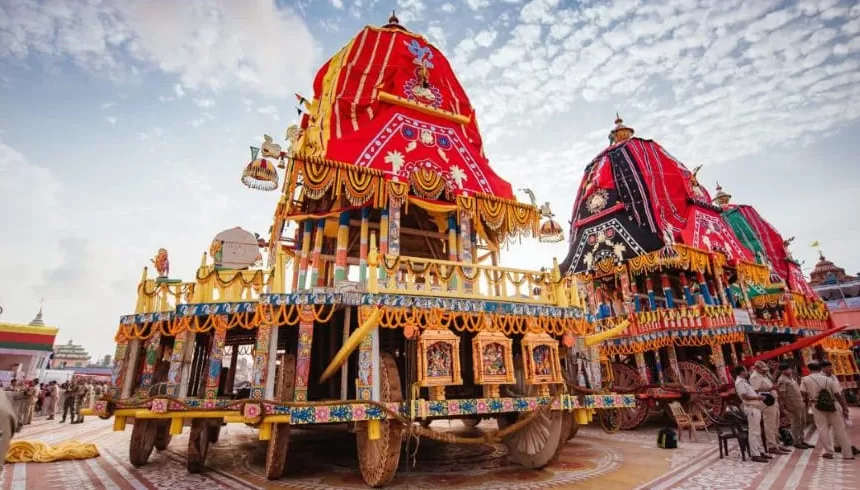
Puri’s Rath Yatra (Chariot Festival) is one of the largest religious processions in the world. Every year in June or July, the idols of Jagannath, Balabhadra, and Subhadra are taken out of the temple in gigantic wooden chariots and pulled by thousands of devotees through the streets of Puri.
The spectacle is so grand that it attracts millions of pilgrims and tourists from around the world. Interestingly, the English word “juggernaut” is derived from this festival, symbolizing a massive, unstoppable force.
4. The Temple Kitchen: World’s Largest Open Kitchen
The Jagannath Temple’s kitchen is considered one of the largest in the world. It prepares food for more than 100,000 people every day during festivals and can feed around 25,000 to 30,000 people on a regular day. The food, known as Mahaprasad, is cooked in earthen pots using firewood and follows a strict ritualistic process.
A curious fact: Despite being cooked one above the other in seven-tiered pots, the top pot is always cooked first, followed by the ones below it.
5. Puri Beach and Sand Art
Puri is also famous for its golden beach, which is ideal for swimming, relaxation, and watching sunrise and sunset. It is also home to internationally acclaimed sand artist Sudarsan Pattnaik, who creates jaw-dropping sculptures on the beach. The beach regularly hosts the Puri Beach Festival, showcasing cultural performances, art, and crafts.
6. Sudarshan Crafts Museum and Handicrafts
For those interested in Odisha’s art heritage, the Sudarshan Crafts Museum in Puri displays stunning stone and wood carvings. The city is also a hub for Pattachitra paintings, a traditional form of scroll painting that dates back to ancient times and narrates mythological stories.
7. Chilika Lake: A Bird Watcher’s Paradise
Just a short drive from Puri lies Chilika Lake, the largest coastal lagoon in India and a haven for migratory birds. From November to February, birds from Siberia, Iran, and the Himalayas flock here, making it a paradise for bird lovers and photographers.
8. Unique Sound and Wind Phenomena
When you enter the Jagannath temple, you hear the roar of the sea. But once inside the inner sanctum, the sound suddenly disappears. Additionally, no shadow of the temple dome falls on the ground at any time of the day—a phenomenon still unexplained by science.
Puri is a city that blends spirituality, science-defying mysteries, rich culture, and natural beauty. Whether you’re a pilgrim, a traveler, or a curious explorer, Puri offers an unforgettable experience that stays with you long after you leave. It’s not just a place to visit—it’s a place to feel, to believe, and to marvel.