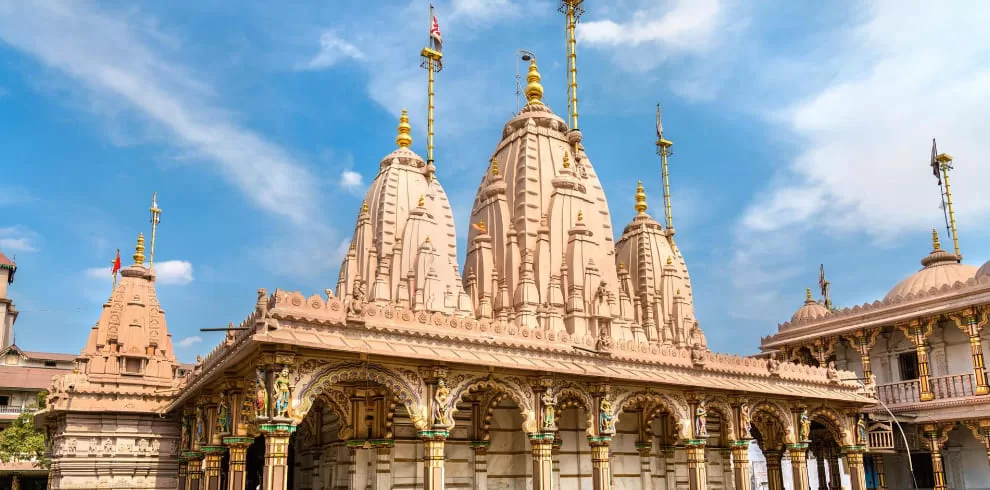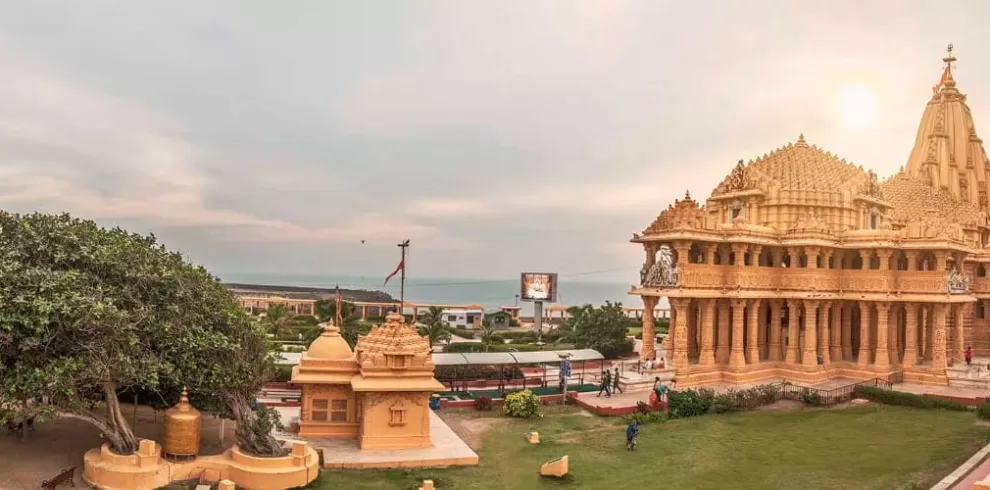
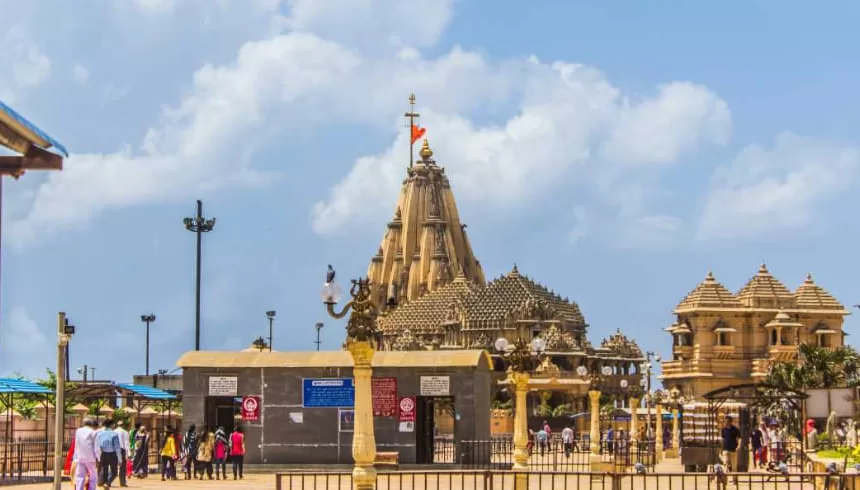
The Somnath Temple, located on the western coast of Gujarat in Prabhas Patan near Veraval, is one of the most revered shrines of Hinduism. Known as the “Eternal Shrine,” it is considered the first among the twelve Jyotirlingas of Lord Shiva. More than just a religious landmark, Somnath stands as a testament to India’s resilience, cultural richness, and architectural grandeur. Its history is deeply intertwined with legends, invasions, reconstructions, and an enduring spirit of devotion that has survived centuries.
Mythological Origins
The story of Somnath begins in Hindu mythology. According to ancient scriptures, the moon god Chandra married 27 daughters of Daksha Prajapati. However, he favored Rohini, neglecting the others. Enraged, Daksha cursed Chandra to lose his luster. Seeking redemption, Chandra worshipped Lord Shiva at Prabhas Patan. Pleased with his penance, Shiva restored his brightness and resided there as Somnath (Lord of the Moon).
This is why the temple is considered the first Jyotirlinga, a place where Shiva manifested in his infinite light form. Ancient texts like the Skanda Purana and Shiva Purana extol its sanctity, making it a pilgrimage of immense spiritual merit.
Ancient Mentions
Somnath’s significance isn’t limited to mythology. References appear in ancient texts and travelers’ accounts:
- The Rig Veda mentions the region’s sacredness.
- Inscriptions from the Mauryan period (c. 3rd century BCE) suggest that Emperor Ashoka supported religious practices here.
- Greek, Arab, and Persian chroniclers often spoke of a magnificent shrine by the Arabian Sea that attracted pilgrims and traders alike.
- The temple’s strategic location made it both a religious center and a prosperous hub for maritime trade.
Early Constructions and Grandeur
The first grand structure of Somnath is believed to have been built in gold by the moon god himself, followed by reconstructions in silver by Ravana, wood by Lord Krishna, and finally stone by the Pandavas, as per legend. Historically, the first documented stone temple is dated around the 4th–5th century CE, during the reign of the Gupta dynasty.
By the 10th century, Somnath had become an immensely wealthy shrine. Pilgrims from across India offered treasures of gold, silver, and jewels. Its fame spread across Asia, making it one of the richest temples of the era.
The Series of Invasions
Somnath’s wealth also attracted repeated invasions, earning it the reputation of being the “temple that refused to die.” It is said to have been destroyed and rebuilt at least seventeen times.
Mahmud of Ghazni (1025 CE)
The most infamous invasion came from Mahmud of Ghazni. In 1025, he plundered Somnath, looting its immense treasures and desecrating the shrine. According to chroniclers, he carried away wealth so vast that it shocked Central Asia. Despite the destruction, the resilience of the devotees ensured the temple was rebuilt.
Subsequent Attacks
Over the centuries, rulers like Alauddin Khilji’s generals, the Delhi Sultanate, and the Mughals also targeted Somnath. Each time it was destroyed, local rulers, saints, and devotees rebuilt it, reflecting the community’s unwavering devotion.
Aurangzeb’s Desecration (1665)
Under Mughal emperor Aurangzeb, Somnath faced another major destruction. For many, this symbolized the darkest chapter in its history. Yet, the shrine continued to live on in collective memory, waiting for revival.
The Rebuilding Phases
Chalukya Restoration
In the 12th century, the temple was magnificently reconstructed by the Solanki ruler Bhima of the Chalukya dynasty. Designed in the Māru-Gurjara style, it became an architectural marvel adorned with intricate carvings, grand spires, and a massive shikhara (spire).
Later Restorations
Despite repeated plunder, the temple’s foundations were never erased. Local devotees preserved its sanctity, rebuilding smaller shrines even when large-scale reconstruction wasn’t possible.
The Modern Rebirth
The modern Somnath Temple that stands today owes its existence to post-independence efforts. After 1947, India’s leaders recognized Somnath’s symbolic importance.
Sardar Vallabhbhai Patel, India’s first Deputy Prime Minister, spearheaded the reconstruction. He declared that Somnath would rise again as a symbol of national pride.
Following Patel’s death, K. M. Munshi, then Union Minister, carried forward the vision. With the support of Prime Minister Jawaharlal Nehru and President Rajendra Prasad, the rebuilding project was completed.
In 1951, the newly reconstructed Somnath Temple was consecrated in grand ceremonies. The modern structure, built in the traditional Chalukya style, stands 155 feet tall with a shikhara that rises majestically over the Arabian Sea.
Architectural Splendor
The Somnath Temple is an outstanding example of Māru-Gurjara architecture. Key features include:
- Shikhara: A towering spire rising 50 meters high, visible from afar.
- Garbhagriha: The sanctum houses the revered Jyotirlinga.
- Mandapas: The halls are adorned with finely detailed stone carvings, depicting deities, mythological stories, and floral motifs.
- Ocean-facing location: The temple overlooks the confluence of three rivers — Hiran, Kapila, and Saraswati (known as Triveni Sangam) — and the Arabian Sea, adding to its spiritual aura.
An inscription on the temple wall notes that it stands on the Indian subcontinent’s westernmost coast, with no land between it and the Arabian Peninsula, emphasizing its symbolic vastness.
Cultural and Religious Importance
Somnath is not just a temple — it is a living tradition. For Hindus, visiting Somnath is considered deeply auspicious. Devotees believe that darshan of the Somnath Jyotirlinga cleanses sins and grants liberation.
The temple also plays a role in festivals and rituals:
- Mahashivratri attracts thousands of pilgrims every year.
- Ritualistic abhishekam (offering of water, milk, honey) is performed daily on the Jyotirlinga.
- Pilgrims often combine Somnath with visits to Dwarka, Girnar, and other sacred sites in Gujarat.
Symbol of Resilience
The Somnath Temple’s history is more than stone and spire; it is the story of India’s resilience. Despite invasions, looting, and repeated desecrations, it was never abandoned. Its multiple reconstructions highlight the spirit of revival that defines Indian civilization.
Sardar Patel’s vision for Somnath was not just about rebuilding a temple but restoring cultural confidence in newly independent India. Today, the temple draws millions of devotees and tourists, standing proudly as a symbol of faith, endurance, and national identity.
The Somnath Temple is rightly called the “Eternal Shrine.” From mythological legends to historical upheavals, from the plunder of invaders to the pride of independent India, it has stood the test of time. Its stones whisper stories of glory, tragedy, and revival. For devotees, it is a place where the divine light of Shiva continues to shine. For historians, it is a mirror of India’s cultural journey.
Visiting Somnath is not just a pilgrimage — it is an encounter with centuries of history, resilience, and devotion etched into every stone. Truly, Somnath remains eternal, a beacon of faith on the shores of the Arabian Sea.
Related Trips