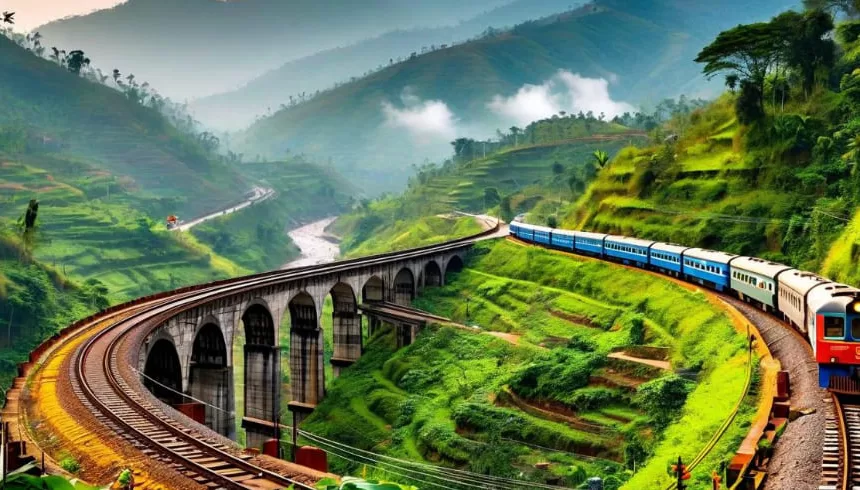
For decades India’s Northeast — eight states rich in biodiversity, culture and history — felt physically distant from the mainland because rail links were few and the terrain formidable. That is changing fast. Over the past ten years Indian Railways has pushed an ambitious programme of broad-gauge conversions, cross-border ties, new lines and strategic projects designed to plug the Northeast directly into the national railway grid. The result: faster passenger travel, cheaper and more reliable freight, and fresh opportunities for trade and tourism. Below is a concise guide to the major routes and projects that are connecting the Northeast to the rest of India — why they matter, where they run, and what’s next.
The backbone: Guwahati and the Barauni–Guwahati corridor
Guwahati is the natural rail hub for the Northeast. The Barauni–Guwahati line (via New Jalpaiguri / New Bongaigaon) has long served as the primary overland link between Kolkata and the Brahmaputra valley. Trains from Howrah/Kolkata and New Jalpaiguri terminate or pass through Guwahati, which then branches out into Assam, Arunachal, Meghalaya, Nagaland, Manipur, Mizoram and Tripura. Improvements to track doubling, electrification and upgraded junctions have helped reduce bottlenecks on this corridor and increase throughput for both passenger and freight traffic.
Tripura & Bangladesh shortcut: Agartala and the Akhaura–Agartala line
Tripura’s rail story is a template for rapid change. Agartala — the state capital — was connected to India’s broad-gauge network after a series of gauge conversions and line extensions; more recently, the Akhaura–Agartala international link with Bangladesh has been transformational. This cross-border connection drastically shortens travel and freight routes between Kolkata and Tripura (and beyond) by routing via Dhaka rather than the much longer domestic loop. For passengers and shippers, that can mean sharply reduced journey times and costs, and for the region, easier access to markets in eastern India and Bangladesh.
The Siliguri–New Jalpaiguri gateway and the chicken-neck challenge
Siliguri / New Jalpaiguri (SIL / NJP) in North Bengal is the “gateway” to the Northeast. The narrow Siliguri Corridor — India’s “chicken-neck” — is strategically vital and all rail traffic from the mainland funnels through or near this stretch. New Jalpaiguri now hosts high-speed services (including Vande Bharat links to Guwahati and Howrah) and serves as the staging point for routes that fan into the Northeast: to New Bongaigaon, Lumding, Rangiya and beyond. Projects that boost capacity here — doubling lines and signal upgrades — have outsized impact on connectivity for the whole region.
Deepening internal links: Lumding, Rangiya, Silchar and the Barak Valley
The Barak Valley (Silchar, Hailakandi) and the hill states east of it have seen steady upgrades. The Rangiya–Silchar–Agartala/Sabroom axis and the Lumding–Dibrugarh trunk allow eastern Assam and the Barak Valley to link to both Guwahati and New Jalpaiguri. Though speeds remain modest due to terrain and many intermediate stops, these routes are critical for social connectivity and for moving agricultural produce and consumer goods. Trains such as the Silchar–Guwahati expresses illustrate how passenger mobility has improved even as work continues on smoothing alignments and reducing transit times.
The new frontier: Mizoram (Bairabi–Sairang) and Arunachal advances
One of the most symbolic projects has been the Bairabi–Sairang line in Mizoram, which finally links Aizawl’s periphery to the national grid. That 51-kilometre stretch required extraordinary tunnelling and bridge work and marks a major milestone in making state capitals directly rail-accessible. Likewise, lines being planned and built in Arunachal and further north — including survey work for routes toward Tawang and other frontier areas — demonstrate a policy push to integrate the region both economically and strategically. These are costly, technically demanding projects but their payoff in inclusion and security is high.
Freight, trade and cross-border potential
Beyond passengers, freight is a compelling driver of Northeast rail expansion. Cheaper rail freight reduces the cost of construction materials, fuel, foodgrain and industrial inputs. Cross-border links (like Akhaura–Agartala) open direct access to Bangladeshi ports and shorten inland supply chains — a strategic advantage for northeastern industries and farmers. The Ministry of Railways and the Northeast Frontier Railway have explicitly prioritised freight corridors and logistics nodes to turn the region into an economic corridor rather than a periphery.
Challenges that remain
Progress is fast but uneven. The key challenges are:
- Terrain and engineering complexity: mountains, rivers and heavy monsoon rains raise construction costs and slow progress.
- Frequency & speed: many long-distance trains still run only a few days a week and average speeds can be low.
- Last-mile access: many new terminals are still some distance from state capitals or tourist hubs, so complementary road upgrades are essential.
- Environmental and social impact: balancing construction with forest conservation, land acquisition concerns and local livelihoods is an ongoing requirement.
What travellers and businesses should know
If you’re planning to travel in or trade with the Northeast:
- Use Guwahati, New Jalpaiguri and Agartala as major interchange hubs for onward journeys.
- Check for new direct services (e.g., Kolkata–Sairang or new Vande Bharat links) that can replace long road alternatives.
- For freight, talk to logistics providers about cross-border routing via Bangladesh where feasible — it can be faster and cheaper.
- The big picture: integration and opportunity
Railways are doing more than moving people and goods — they’re knitting the Northeast into India’s economic fabric. Massive public investment and targeted projects are shortening distances, cutting costs and opening fresh economic corridors. As frequency, speeds and last-mile links improve, expect spikes in tourism, easier market access for farmers, and a clearer path for industries seeking competitive logistics. For a region long defined by distance and difficult terrain, rail is turning geography from a handicap into an asset.
Related Trips